
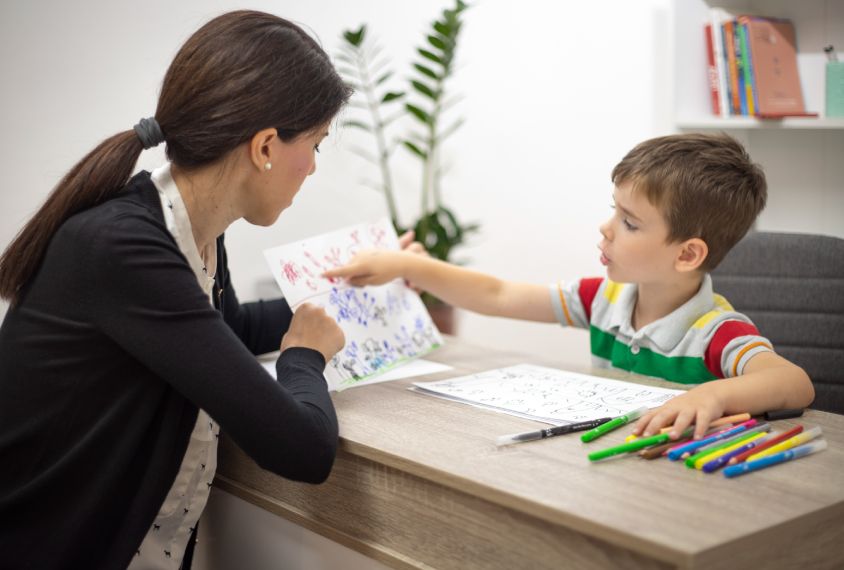
In DIRFloortime®, the letter I stands for individual differences. Sometimes this is the part that changes everything.
Two children with the same diagnosis can be very different. One seeks movement; another quickly becomes overwhelmed by it. One covers their ears in response to everyday sounds; another seems not to hear when someone speaks to them. One talks a great deal but loses the thread in an emotionally demanding situation. Another speaks very little but communicates their intentions precisely through their body, gaze, actions, or pauses.
If we look only at the diagnosis, it is easy to apply a ready-made formula to the child. When we look at their individual profile, we begin to understand what helps this particular child connect, learn, play, communicate, and cope with the world.
An individual profile is not a list of “deficits.” It is a map. It includes difficulties, but also strengths: what interests the child, what brings them to life, how they take in information most readily, what pace suits them, and what helps us reach them and sustain their interest. That might be movement, sound, images, bodily sensations, humor, predictability, or rhythm.
In DIRFloortime® training, the DIR 201 course specifically addresses the ability to describe an individual profile: sensory reactivity, information processing, motor planning, receptive and expressive language, and visual-spatial characteristics. This isn’t just theory. Without that understanding, Floortime® can easily become a set of nice-sounding ideas.
For example, if a child does not join in play, we need to understand why. Are they uninterested? Is it too fast or too loud? Have they understood the idea? Is it difficult to plan the movement? Are they afraid of making a mistake? Do they need more time to respond? Have they already run out of energy?
The answers change how we offer support. One child needs more affect and emotional expressiveness. Another needs a quieter voice, a slower pace, and fewer words. Movement helps one child; physical support helps another. A third needs visual cues that make things predictable, while a fourth needs an adult who can simply wait patiently for a response.
Good support begins with understanding the child and choosing a way of interacting that makes development possible for them. It doesn’t begin with fitting the child to a method.
In this sense, the individual profile is one of the central tools of DIRFloortime®, not an optional addition.
Online DIR 101: preliminary registration
If you would like a systematic introduction to the approach, preliminary registration is open for an introductory online DIR 101 course taught in Russian. Once we have a group of 5–6 people, we will find a time that works for everyone and schedule the course on the ICDL Institute (USA) website. Registering your interest does not commit you to paying.
Related reading in English
- Supporting Neurodivergent Clients: Recommendations for Practitioners, Part 1
- Neurodiversity and Neurodivergence: What Is the Difference?
- Regulation and Self-Regulation
- Following the Child’s Lead Does Not Mean Doing Nothing
- High Sensitivity in Neurodivergent People
Neurodivergence resources · DIRFloortime® · Sessions, training, and supervision