

When we talk about DIRFloortime®, we sometimes need to explain that it isn’t “just playing with a child.” Believe me, this is not about fooling around!
Play matters, but not because adults have decided to make therapy more pleasant. Play, emotion, connection, and relationships give a child room to develop regulation, communication, initiative, thinking, and the ability to be with another person. We can work through the child’s interest, rather than through resistance, difficulty, and “I don’t want to.”
Evidence matters. Especially in support for children with developmental differences, where parents are offered so many methods, promises, and frightening predictions. Parents and practitioners need to know that an approach rests on more than an appealing idea. It needs clinical reasoning, experience in practice, and research.
On its research page, ICDL describes DIRFloortime® as a developmental, individualized, interdisciplinary approach. That distinction matters: it is harder to study an approach like this than a method designed to teach one skill or change one behavior. DIRFloortime® looks more broadly at development, relationships, communication, family involvement, emotional connection, and the ability to interact.
DIRFloortime® research looks beyond whether a child has become easier for adults to manage. Other questions matter: Is communication growing? Is there more shared experience? Are functional emotional capacities developing? Is the child taking more initiative? Is parental stress decreasing? Is family interaction becoming more lively and more stable?
This is fundamental to me. Helping a child must mean more than making them less inconvenient for adults. Good support should open up possibilities: to connect, express themselves, understand someone else, cope with overload, play, think, want, choose, and build relationships.
ICDL’s research page brings together different kinds of studies: clinical cases, group studies, randomized controlled trials, and systematic reviews. It notes that several studies of Floortime® with autistic children found improvements in functioning and communication, while parental stress did not increase and, in some studies, decreased.
That matters enormously. An approach that involves parents should not turn them into exhausted, full-time therapists!
In good DIR practice, parents aren’t left alone with the instruction to “do more.” They receive support, a better understanding of their child, and more finely tuned ways of being together. Sometimes this is what eases the helplessness: understanding what is happening, and how to help without a constant battle.
Evidence for DIRFloortime® doesn’t erase individuality, either. Research doesn’t tell us to do exactly the same thing with every child. It supports the thinking behind the approach: build development through relationships, take account of the child’s individual profile, and work with the foundations of regulation, communication, and thinking, not only with behavior.
So when I talk about DIRFloortime®, I’m not talking about a fashionable way to play on the floor. I’m talking about an approach with a theory of development, clinical practice, professional training, an international professional framework, and a growing research base.
It also has recognition and strong support within the international community of autistic adults advocating for autistic people’s rights. Autistic adults themselves are calling for gentler, non-coercive ways of raising and supporting children. Shouldn’t we listen to people who have lived through different therapeutic approaches themselves?
And throughout DIRFloortime®, the child remains a person, not a collection of behaviors to correct.
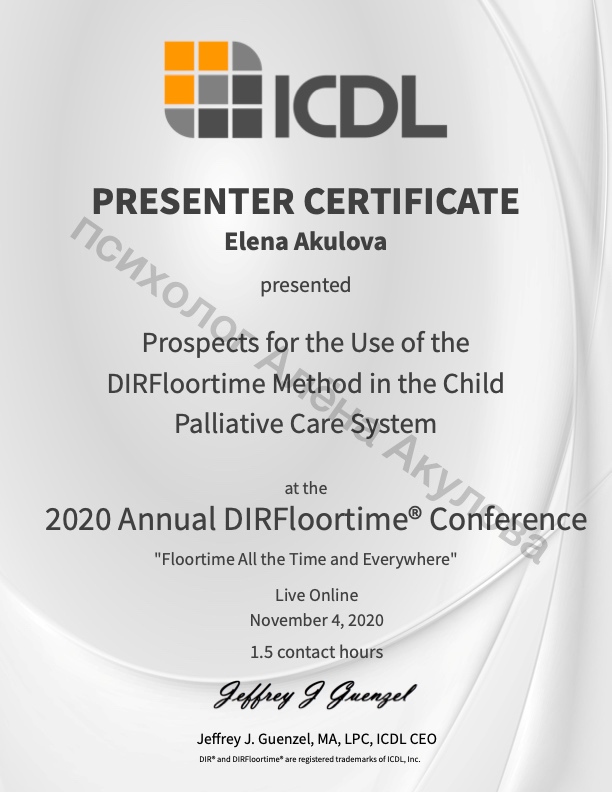
In 2020, I presented “Prospects for Using DIRFloortime in Children’s Palliative Care” at two conferences: a Russian-language DIRFloortime® community conference and an international English-language conference organized by ICDL in the United States. I presented alongside children’s hospice director A. G. Gorchakova, sharing our experience of using DIRFloortime® principles with children receiving palliative care.
Yes, children whose health conditions can be so severe that many are considered unable to learn. Children’s palliative care includes many children with neurological conditions and multiple health difficulties. Even with this group, we saw good results with DIRFloortime®.
DIR principles also fit well with the coordinated work of a multidisciplinary palliative care team. They sit naturally alongside the central principles of palliative care: an individual approach, with the support system adapted to each child’s profile.
Other approaches had proved insufficient for this group of children. In palliative care, we could not rely on a system of motivating and rewarding a child. Development through relationships and emotions, though, brought very strong results. Imagine the possibilities for children with much less severe difficulties.
Related reading
- What Is DIRFloortime®? A Plain-English Introduction
- Frequently Asked Questions About DIRFloortime®
- Functional Emotional Developmental Capacities: A Map for Growth
Explore DIRFloortime® · Sessions, training, and supervision
Online DIR 101: register your interest
If you would like a structured introduction to the approach, you can register your interest in an introductory online DIR 101 course taught in Russian. Once we have a group of 5–6 people, we will find a time that works for everyone and schedule the course on the ICDL Institute (USA) website. Registering your interest does not commit you to paying.